
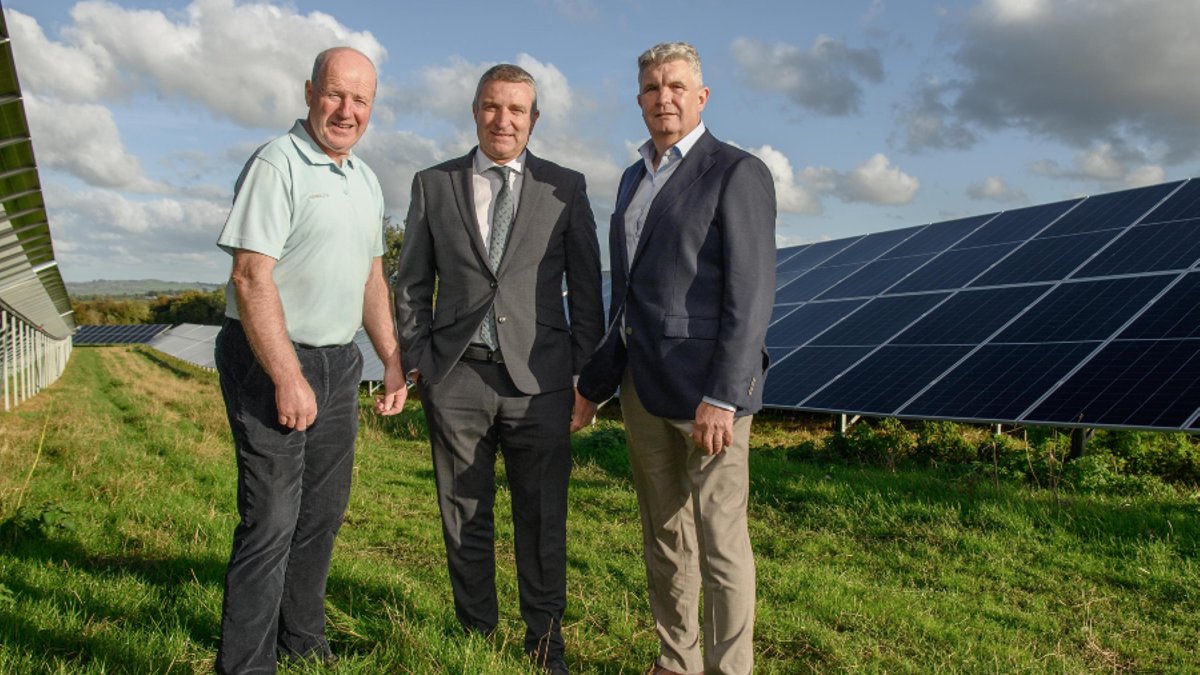
A 650-kilowatt solar farm in Cork has become Ireland’s first renewable energy project to operate under the Government’s Small-Scale Renewable Electricity Support Scheme (SRESS), demonstrating a new approach for farmers and rural businesses to generate clean power.
The project combines traditional farming with renewable energy production by allowing sheep to graze under more than 1,000 solar panels. This agrivoltaic approach eliminates land-use conflicts while providing farmers with additional income without disrupting existing operations.
Long-Term Power Purchase Secures Revenue
Such long-term contracts are essential for making small-scale renewable projects financially viable by providing the certainty needed to attract investment.
Ken O’Byrne, managing director of Flogas Energy, described the partnership as a milestone for rural renewable energy. “Our role is to provide the commercial certainty that gives projects like this a route to market and helps unlock the investment needed to bring them forward,” he said. “We see significant potential for this model to support more farmers, SMEs and independent renewable developers across rural Ireland.” The SRESS scheme, introduced last year, targets projects producing between 50 kW and 6 MW, offering guaranteed payments for electricity—a benefit previously difficult for smaller developers to access.
For Keating, the project represents the end of nearly a decade of planning. Development began in 2017, but required overcoming challenges related to planning permissions, grid connections, and financing.
Government Boosts Rural Renewable Transition
Minister for Climate, Energy and the Environment Darragh O’Brien emphasized the project’s importance in Ireland’s broader energy transition. “As Ireland works towards our climate and renewable energy targets, projects like this will have an important role to play in expanding our renewable generation capacity and supporting a more sustainable energy system,” he noted. The scheme reduces financial risks for farmers and rural communities, helping them contribute to Ireland’s renewable energy goals.
Its success could inspire other landowners to diversify income while supporting climate goals. With the project now operational, focus will shift to whether similar agreements can expand nationwide.
Open Day Showcases Rural Energy Model
Minister of State at the Department of Agriculture, Food and the Marine Niall Collins attended the event, highlighting how the farm aligns with efforts to promote sustainable farming. He noted that diversification, such as integrating renewable energy, is becoming essential for farming families to ensure long-term business stability. The project proves that renewable energy can complement agriculture without disrupting operations, offering farmers new revenue while preserving their land’s primary use.
The project’s completion fulfills a decade-long vision for Keating to secure his family farm’s future. “Bringing it to life required significant work across planning, the ESB grid connection and financing,” Keating said. I would also like to extend my sincere thanks to our project partners Bank of Ireland/SBCI and PV Generation Ltd. It was the support of both, and in particular that of PV Generation Ltd, that was critical in making this milestone possible.”


