
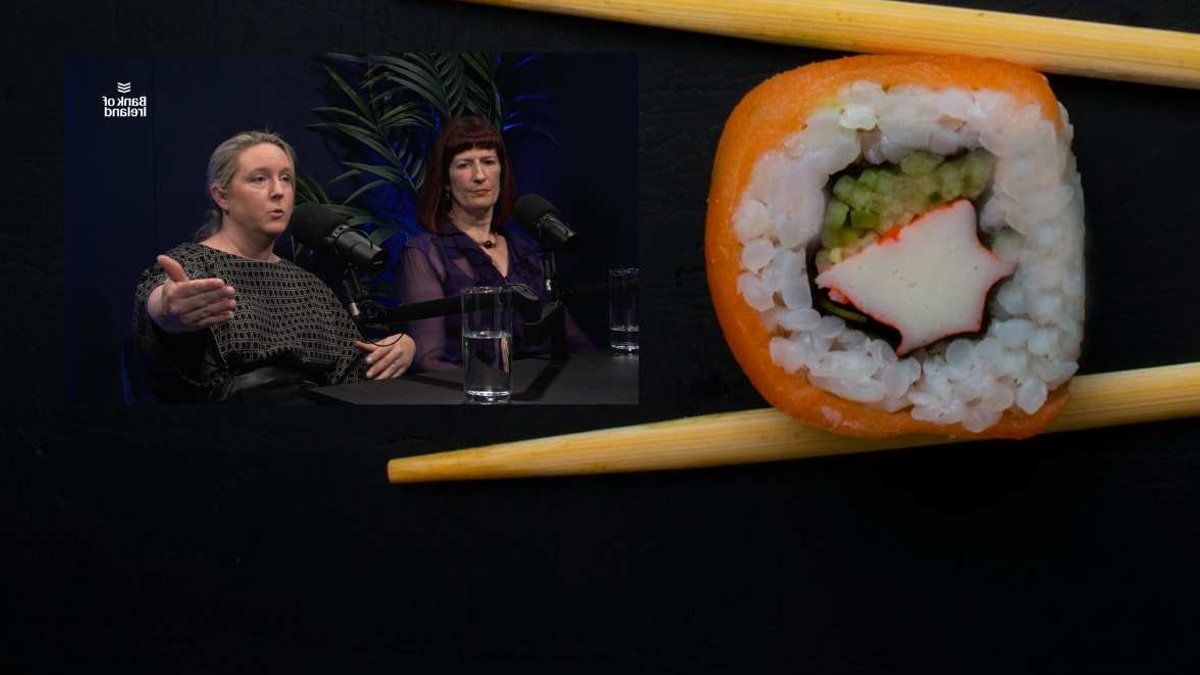
Ciara Troy developed the Irish sushi brand Oishii from a small Greystones market stall into a fixture on shop fridge shelves across Ireland. Twenty years later, she and Bank of Ireland’s head of Food and Beverage Sector Lucy Ryan discuss the essentials required to launch a food enterprise and sustain its presence.
Troy set up her stall at the Meridian Centre in Greystones, County Wicklow, in 2006, with a Tefal rice cooker, a bamboo mat, and a handheld fan for glossing the rice. She had no business plan, no funding, and no particular idea what she was doing. However, she did have a supplier, Stephen from Harvey Seafoods, who became her first supplier and still supplies her to this day.
Nearly two decades later, Oishii Foods distributes fresh sushi to supermarkets and forecourts across Ireland, employs 75 people, and operates from a purpose-built factory in Dublin 12. Troy’s journey has been a long and grinding process of turning a good idea into something that actually makes money.
Oishii’s Early Days
Troy’s interest in Japanese food began with a semester in Tokyo as part of her degree at Trinity College Dublin. She returned to Ireland convinced that the country was missing out on the benefits of a rice-based diet. She started Oishii that same summer, making Japanese food for farmers’ markets.
The early months were a proving ground for Troy, with the markets giving her real-time consumer feedback at the lowest possible cost of entry. She learned quickly what people would pay, what they came back for, and what they ignored. She had a range of products, including lemon and green tea drizzle cakes, gyoza, yakitori, and miso soup, but most of them were eventually dropped in favor of sushi.
Troy identifies a near-collision while driving her refrigerated van after a pre-dawn shift at the kitchen as her real wake-up call. The incident made her realize that she couldn’t continue running the business on her own and led her to hire her first salesperson shortly afterwards.
Challenges Food Startups Face
Lucy Ryan, who spent over 20 years working in the food industry before joining Bank of Ireland, recognizes the challenges food start-ups face. She notes that many founders do not fully understand their cost base and may not know what it costs to produce their product, what margin a retailer will demand, or what a logistics company will need on top of that.
Troy’s own financial education came via her brother-in-law and a simple spreadsheet. He asked her how many trays she made each week, how many hours people had worked, and what the materials cost. The exercise led her to the Wicklow Enterprise Board, which provided financial mentoring and helped her put together a capital funding application.
Ryan points to a broader set of supports that food businesses often fail to use, including Local Enterprise Offices, county council grants, and sector bodies such as Bord Bia and Enterprise Ireland. These organizations provide a mix of mentoring, networking, and funding access that can make a material difference at an early stage.
Building Efficiency And Scale
Troy’s approach to building her business has been focused on efficiency and scale. She has invested in machinery and space, including a bigger kitchen in Bray and a move to the Spade Enterprise Centre in Smithfield. Each move has followed the same logic: efficiency first, then scale.
One of the challenges Troy faces is the supply chain, which she can only partially oversee. Troy has built quality ownership into the entire workforce, recognizing that every step in the chain is important.
Troy has also focused on keeping prices stable while costs rise. Oishii has not raised its retail prices despite sustained inflationary pressure across food inputs. Instead, the company has focused on internal efficiency at its Dublin 12 factory, consolidating procurement, buying in bulk, and streamlining processes.
Troy’s goal has always been to make Oishii an affordable luxury, with quality at an affordable price. She recognizes that sushi will never be cheap, but she wants it to be a regular purchase, built on repeat custom.
Ryan notes that Irish consumers are dealing with a split in their spending, with more than half buying private label products in supermarkets, yet remaining willing to pay a premium for fresh, convenient, high-quality food when the proposition is clear.
Shifting Consumer Demands
Troy points to demographic change as another factor reshaping demand, with a surge in popularity of Korean and Japanese influences, such as kimchi and beef bulgogi. A business built on introducing sushi to Irish forecourts two decades ago now looks less like an outlier and more like an early signal.
Troy is candid about her early limitations as a manager, recognizing that she was in her twenties and could barely lead herself, let alone other people. She has evolved her approach over time, paying people well for the things she was weakest at and building an agile team.
Oishii still employs 75 people making sushi largely by hand, but Troy sees robotics as the direction of travel, not as a threat to employment but as a way of redirecting it toward higher-value roles.
The company is also facing pressure on packaging, with sushi trays predominantly made of plastic and rising oil prices adding cost. Troy sees this as an opportunity for compostable alternatives, even if they remain more expensive for now.
Troy’s advice to anyone starting a food business today is to plan before the rain comes, understand the macro forces, use the supports that exist, and ask for help earlier than feels comfortable. She notes that no one is an island and that reaching out to supports and finding the right advice is important.
According to local reports, Oishii received an unannounced audit the day before the conversation, which is a twice-yearly event given that sushi is classified as high-risk food, and the company relies on refrigerated haulage companies, depot handling, and in-store management, none of which it employs, with 75 staff working to ensure the quality of the products.


